
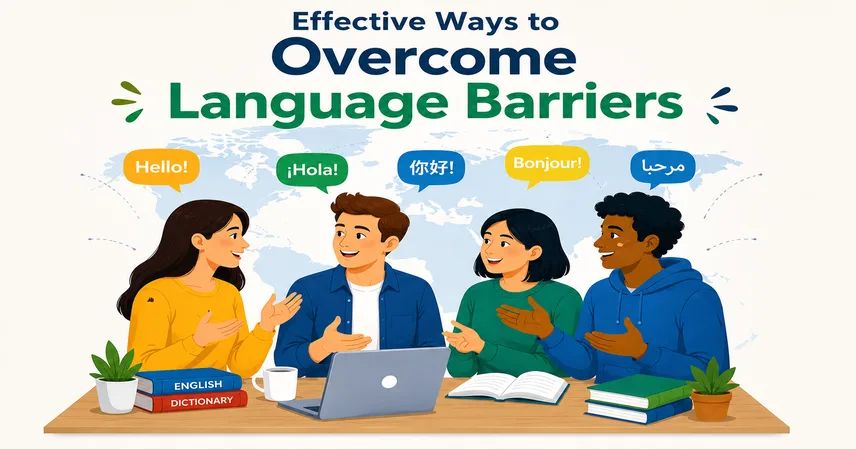
Studying abroad does not require you to speak a new language perfectly. It requires you to communicate well enough to learn, participate, solve everyday problems, build relationships, and gradually become more independent.
That distinction matters because a student can have strong test scores and still struggle with real-world communication. A lecture may be easier to understand than a fast conversation between local students. Reading a textbook may feel comfortable while participating in a spontaneous discussion feels difficult. A student may also know the vocabulary but hesitate to speak because of fear of making mistakes.
Read More: 7 Smart Ways to Manage Your Living Expenses While Studying Abroad
A language barrier is therefore not simply a vocabulary problem. It can involve listening speed, pronunciation, unfamiliar expressions, academic terminology, confidence, cultural communication styles, and the ability to ask for clarification when something is unclear.
The goal should not be to eliminate every mistake. The goal is to progressively reduce the Communication Gap between what you need to accomplish and what you can currently communicate.
This guide presents nine practical ways to do that while studying abroad.
At a Glance: The 9 Ways to Overcome Language Barriers
- Prepare for the language situations you will actually encounter.
- Build a personal vocabulary system instead of memorizing random words.
- Practise speaking through controlled daily exposure.
- Learn clarification and repair strategies.
- Use translation technology without becoming dependent on it.
- Create social environments that force useful communication.
- Develop listening skills for real-world speech and different accents.
- Use university language and academic support before problems become serious.
- Measure progress by communication ability, not perfection.
The key principle is simple: Do not try to become fluent in everything at once. Become more capable in the situations that matter most to your life abroad.
1. Prepare for the Language Situations You Will Actually Encounter
Before studying abroad, many students focus on memorizing vocabulary or improving their general grammar. Those activities can help, but preparation becomes much more effective when it is connected to the situations you are likely to face. Think about your first 30 days abroad. You may need to:
- Introduce yourself to classmates.
- Speak with university staff.
- Ask for directions.
- Buy groceries.
- Open a bank account.
- Discuss housing.
- Visit a doctor or pharmacy.
- Understand transportation announcements.
- Ask a professor about an assignment.
- Participate in classroom discussions.
- Make small talk with classmates.
- Explain a problem when something goes wrong.
These situations require different kinds of language. A useful preparation system is the Language Situation Map.
| Situation | Language Needed | Priority |
|---|---|---|
| University administration | Formal questions and documents | High |
| Classroom | Academic vocabulary and clarification | High |
| Housing | Contracts, repairs, utilities | High |
| Healthcare | Symptoms and personal information | High |
| Transportation | Directions and timing | Medium |
| Shopping | Everyday vocabulary | Medium |
| Social life | Informal conversation | High |
| Academic writing | Formal structure and terminology | High |
Instead of asking, “How can I improve my language?” Ask: “Which communication situations could create serious problems if I cannot handle them?”
That question gives your preparation a much clearer direction. EducationUSA similarly encourages students to define their priorities, goals, program type, language level, and ability to adjust to their new environment rather than treating language preparation as a one-size-fits-all process.
2. Build a Personal Vocabulary System
A generic vocabulary list may teach you thousands of words that you rarely use. A personal vocabulary system is different because it grows from your actual environment. Create separate categories such as:
- Academic vocabulary
- Housing
- Transportation
- Healthcare
- Administration
- Social conversation
- Everyday activities
- Field-specific terminology
For each useful word or expression, record: Word → Meaning → Example → Context → Your own sentence For example: “Extension” Meaning: additional time allowed for completing something. Context: assignment deadline.
Your sentence: “Could I request an extension because of the circumstances I explained?” This is more useful than memorizing a dictionary definition because the word becomes connected to an actual situation.
Use the Encounter-Use-Review cycle
When you encounter a new expression:
Encounter → Understand → Use → Review
Do not stop after understanding it. If you encounter an expression in class, try to use it later in a conversation, discussion, email, or piece of writing. Your vocabulary becomes valuable when it moves from recognition to active use.
3. Practise Speaking Through Controlled Daily Exposure
Many students know that they should speak more, but “speak more” is too vague to become a reliable habit. Create small communication targets instead, for example:
- Day 1: introduce yourself to someone new.
- Day 2: ask a classmate one academic question.
- Day 3: order food without relying on a translation tool.
- Day 4: have a five-minute conversation.
- Day 5: ask a university staff member a question.
The objective is not to produce perfect English or another target language. The objective is to increase communication exposure.
The Communication Exposure Equation
If you practise only occasionally, progress is likely to be inconsistent. If every conversation is extremely difficult, you may become discouraged. The best approach is to gradually increase the difficulty. Start with familiar situations, then move toward conversations that require more spontaneous language, for example: Ordering food → Small talk → Academic discussion → Group discussion → Presentation → Debate
This creates a Communication Difficulty Ladder. You do not have to jump from basic conversation directly to public speaking.
4. Learn How to Clarify, Repair, and Confirm
One of the most underrated language skills is not knowing more words. It is knowing what to do when communication breaks down. Imagine a professor gives an assignment instruction and you understand 80% of it. The remaining 20% could determine whether you complete the assignment correctly. Remaining silent is risky. Instead, develop a Communication Repair Toolkit. Useful strategies include:
- Asking someone to repeat something.
- Asking someone to speak more slowly.
- Requesting an example.
- Confirming what you think you heard.
- Asking what an unfamiliar expression means.
- Rephrasing the instruction in your own words.
- Asking a follow-up question.
The structure is: Listen → Identify the gap → Clarify → Confirm → Act
For example: “Just to make sure I understand, do you want us to compare the two theories rather than simply describe them?” That is much stronger than pretending you understand.
Why clarification matters academically
Language misunderstandings can affect:
- Assignment requirements
- Deadlines
- Examination instructions
- Group projects
- Presentation expectations
- Academic policies
- Feedback from professors
A communication problem becomes an academic problem when the student does not identify it early. Clarification is therefore an academic skill, not merely a language skill.
5. Use Translation Technology Without Becoming Dependent on It
Translation apps, dictionaries, subtitles, and other digital tools can be extremely useful when you are adjusting to a new environment. They can help you:
- Understand unfamiliar vocabulary.
- Read signs.
- Interpret administrative information.
- Check an expression.
- Understand menus.
- Decode unfamiliar messages.
- Prepare before communicating.
But there is an important distinction between using translation as support and using translation as a permanent substitute for communication. A useful progression is: Translate → Understand → Practise → Communicate Independently, for example, if you use a translator to understand a phrase, do not stop there. Ask:
- What does the phrase mean?
- How would a person naturally say it?
- In what situation would I use it?
- Can I say it without the tool next time?
This turns technology into a learning mechanism.
The Translation Dependency Test
Ask yourself: “If my translation app disappeared tomorrow, could I still handle this situation?”
If the answer is consistently no, you may be using technology as a communication crutch rather than a learning tool. The objective is not to stop using technology completely. It is to make your independence increase over time.
6. Create Social Environments That Require Communication
Language improves faster when communication becomes part of something meaningful. Instead of thinking only about “language practice,” choose activities that naturally require interaction. Consider:
- Student clubs
- Sports
- Volunteer organizations
- Study groups
- Campus events
- Academic societies
- Cultural organizations
- Part-time activities where appropriate
- Language exchange programs
Choose activities based on genuine interests. If you enjoy photography, a photography club gives you something to discuss. If you enjoy entrepreneurship, an entrepreneurship society creates natural conversation topics. If you enjoy sports, training sessions create repeated interactions.
Read More: Culture Shock While Studying Abroad: 12 Tips to Adapt Faster and Feel at Home
This leads to a useful principle: Shared Interest + Repeated Interaction = Lower Communication Anxiety. You do not need to force yourself into random conversations every day. Instead, create environments where conversation happens naturally.
Avoid the social isolation trap
Friends from your home country can provide important emotional support. You do not need to abandon them. The problem occurs when your entire social environment uses only your native language. A healthier model is: Home-language support + local interaction + international interaction. This gives you emotional security while still expanding your communication environment.
7. Develop Listening Skills for Real-World Speech
A student may understand a teacher clearly but struggle to understand classmates. That does not necessarily mean the student’s language ability is poor. Classroom speech can be relatively structured. Everyday conversation can involve:
- Faster speech
- Reduced pronunciation
- Slang
- Idioms
- Humor
- Interruptions
- Different accents
- Background noise
- Multiple people speaking
Therefore, listening practice should not rely exclusively on formal educational material.
Listening skills can improve gradually by increasing the difficulty and variety of what you hear. The table below provides a practical progression from clear educational speech to natural conversations in everyday environments.
| No. | Listening Level | Recommended Exposure |
|---|---|---|
| 1 | Clear Educational Speech | Lectures, learning videos, and structured explanations with relatively clear pronunciation and pacing. |
| 2 | Everyday Conversations | Interviews, podcasts, and conversations similar to those you may hear on campus. |
| 3 | Different Accents and Speaking Speeds | Listen to speakers from different regions and gradually become comfortable with varied pronunciation and pacing. |
| 4 | Group Communication | Practice listening to multiple people as they interrupt, respond, change topics, and interact naturally. |
| 5 | Real-World Environments | Listen and participate in cafés, public spaces, events, campus activities, and spontaneous conversations. |
Your goal is not to understand every word. Your goal is to understand enough meaning to participate effectively. If you miss a word but understand the main point, communication has still succeeded.
8. Use University Language and Academic Support Before Problems Become Serious
One mistake international students sometimes make is assuming that asking for language support means they are academically weak. It does not. Universities may provide different forms of assistance, including:
- Writing centers
- Language centers
- Conversation groups
- Tutoring
- Academic skills workshops
- International student advisers
- Faculty office hours
- Peer support
- Orientation programs
EducationUSA’s guidance for students preparing to study in the United States specifically highlights pre-departure preparation and orientation as opportunities to understand academic expectations, cultural differences, housing, and adjustment challenges. Before or immediately after arrival, find out: Where can I get help if language becomes an academic problem? Do not wait until you receive a poor grade.
Use the Early Support Rule
Seek support when language difficulties begin affecting:
- Your grades
- Assignment completion
- Classroom participation
- Understanding instructions
- Communication with university staff
- Group work
- Confidence in academic settings
The earlier you identify the problem, the more options you usually have. EducationUSA also notes that English-language programs can develop reading, writing, listening, and speaking skills, with some programs focused specifically on academic English.
9. Measure Progress by Communication Ability, Not Perfection
Language development is rarely linear. You may have a conversation one day that feels effortless and another conversation the next day that feels surprisingly difficult. Instead of asking: “Am I fluent yet?” measure specific abilities.
The Eduvago Language Adaptation Score
Rate yourself from 1–5 in six areas:
| Skill | Score |
|---|---|
| Understanding lectures | /5 |
| Participating in discussions | /5 |
| Everyday conversation | /5 |
| Understanding different accents | /5 |
| Asking for clarification | /5 |
| Academic writing | /5 |
Total: /30
Do this once every two to four weeks. The purpose is not to create a scientific measurement of language proficiency. It is an Eduvago self-audit that helps identify where your communication system needs more practice. Suppose your results are:
- Lectures: 4
- Discussions: 2
- Everyday conversation: 4
- Accents: 2
- Clarification: 5
- Academic writing: 4
Your overall language ability may be reasonably strong, but the score reveals two specific weaknesses: Discussion participation + listening to different accents. That is much more actionable than simply saying, “My English is bad.”
Diagnose the Real Problem Before Choosing the Solution
Not every language barrier requires the same response. Use this simple diagnosis:
| Problem | Likely Priority |
|---|---|
| I know the words but cannot speak | Speaking exposure |
| I understand writing but not conversations | Listening |
| I understand lectures but not classmates | Natural speech exposure |
| I can speak but struggle academically | Academic language |
| I understand but cannot respond quickly | Retrieval practice |
| I am afraid of making mistakes | Low-pressure interaction |
| I depend heavily on translation | Independent communication practice |
| I understand instructions incorrectly | Clarification and confirmation |
| My language problem is affecting grades | University academic support |
This is one of the most important changes in mindset: Do not treat “language barrier” as one problem. Diagnose the specific communication gap first.
Academic Language Requires Its Own Strategy
Being comfortable ordering food does not automatically mean you are ready for university-level academic communication. Academic environments may require you to:
- Interpret complex arguments.
- Compare theories.
- Explain evidence.
- Write structured assignments.
- Participate in seminars.
- Give presentations.
- Defend an opinion.
- Understand discipline-specific terminology.
- Respond to feedback.
Therefore, international students should develop both: Social Communication + Academic Communication
Social communication
Focuses on:
- Conversation
- Listening
- Informal expressions
- Cultural cues
- Everyday vocabulary
Academic communication
Focuses on:
- Discipline-specific terminology
- Formal writing
- Academic discussion
- Presentations
- Critical responses
- Assignment instructions
A student who develops only social communication may still struggle academically. A student who develops only academic language may struggle to build relationships. Strong adaptation requires both.
30 Day Language Barrier Action Plan
You do not need to transform your language ability immediately.
Days 1–7: Diagnose
Identify your three biggest communication difficulties. For example:
- Understanding fast speech
- Speaking spontaneously
- Academic vocabulary
Days 8–14: Increase exposure
Create daily opportunities to use the language. Aim for small, repeatable interactions rather than unrealistic study sessions.
Days 15–21: Increase difficulty
Move from simple conversations toward more challenging communication, for example: One-to-one conversation → group discussion → academic discussion
Days 22–30: Measure and adjust
Repeat your self-audit. Ask:
- What became easier?
- What remains difficult?
- Which situation still creates anxiety?
- What vocabulary do I repeatedly need?
- Where do I still depend on translation?
- Which university resource should I use?
Then build the next 30-day cycle around the weakest area.
3 Evidence-Based Lessons for International Students
1. Language preparation should match your actual academic goal
EducationUSA emphasizes defining individual priorities, goals, program type, and language level when choosing language-learning options. This supports a practical principle: preparation should be connected to what you will actually need to do, not simply to a vague goal of “becoming fluent.”
2. Language ability includes multiple communication skills
EducationUSA describes English-language study in terms of reading, writing, listening, and speaking, and notes that some programs focus specifically on academic English. This reinforces the importance of developing both everyday and academic communication rather than focusing exclusively on vocabulary or grammar.
3. Preparation and support should continue after arrival
EducationUSA’s pre-departure guidance encourages students to use orientations and institutional resources to prepare for academic systems, cultural differences, and adjustment challenges. Language adaptation should therefore be treated as an ongoing process rather than something that must be completed before departure.
Common Mistakes International Students Should Avoid
1. Waiting until your language is perfect before speaking
Confidence usually develops through repeated communication, not through waiting for every mistake to disappear.
2. Memorizing vocabulary without using it
A word you recognize but cannot retrieve during a conversation has limited practical value.
3. Depending on translation for every interaction
Technology can help you understand, but excessive dependence can slow the development of independent communication.
4. Avoiding local or international interaction
Your home-country friends can provide valuable support, but you also need opportunities to communicate beyond your familiar language environment.
5. Focusing only on grammar
Grammar matters, but communication also requires listening, retrieval speed, clarification, cultural awareness, and confidence.
6. Ignoring academic language
Conversational fluency does not automatically prepare you for research papers, seminars, presentations, or academic discussions.
7. Treating every communication failure as a personal failure
Sometimes the problem is simply unfamiliar vocabulary, accent, speed, context, or communication style. Diagnose the situation before judging your ability.
8. Waiting too long to seek university support
If language difficulties begin affecting academic performance, early support is usually more useful than trying to solve everything alone.
Your Language Barrier Survival Checklist
Before and during your study abroad experience, make sure you can answer:
- What language situations will I encounter most frequently?
- Which academic vocabulary do I need?
- Can I introduce myself comfortably?
- Can I ask for clarification?
- Can I confirm that I understood an instruction correctly?
- Can I communicate without immediately translating everything?
- Do I regularly speak with people outside my native-language circle?
- Can I understand different speaking speeds and accents?
- Do I know where my university provides language or academic support?
- What is currently my biggest communication weakness?
- How will I measure improvement?
- What will I practise during the next 30 days?
If you cannot answer these questions, you do not necessarily need more vocabulary. You may need a better communication strategy.
Final Options: Build Communication Confidence, Not Perfect Language
Overcoming a language barrier while studying abroad is not a one-time achievement. It is an adaptation process. You may arrive knowing the grammar but struggle with accents. You may understand lectures but hesitate to speak in discussions. You may communicate comfortably with classmates but struggle with academic writing. These differences are normal because language ability is not a single skill.
The strongest strategy is therefore to identify the specific communication gap, practise it repeatedly, use technology strategically, create real opportunities for interaction, and seek university support when the problem begins affecting your academic life. Think of progress as a gradual transition: Translate → Understand → Practise → Participate → Communicate Independently
You do not need to eliminate every mistake to succeed abroad. You need to become increasingly capable of understanding, responding, clarifying, participating, and recovering when communication breaks down. That is a much more realistic—and much more useful—definition of overcoming a language barrier.
Common Questions About Overcoming Language Barriers While Studying Abroad
1. Can I study abroad if my language skills are not perfect?
Yes, provided you meet the language requirements of your chosen program. Meeting a formal language requirement, however, does not mean you will immediately feel comfortable with every real-world conversation. You should expect continued development after arrival.
2. What is the fastest way to improve my language skills abroad?
Prioritize frequent, meaningful communication. Short daily conversations, academic discussions, language exchanges, campus activities, and regular listening practice can create more useful exposure than studying vocabulary without using it.
3. Should I stop speaking my native language while studying abroad?
No. Your native language can provide valuable emotional and social support. The goal is not to eliminate it but to ensure that you also create regular opportunities to communicate in the language used in your academic and local environment.
4. What should I do if I cannot understand my professor?
First, identify exactly what you did not understand. Ask for clarification, review the relevant course material, discuss the issue with classmates, or use your university’s academic or language support services if the problem continues.
5. Are translation apps bad for language learning?
No. Translation tools can be extremely useful, especially during the early stages of adjustment. The problem is not using them; the problem is becoming unable to communicate without them. Use translation to understand, then practise the expression so that you can eventually use it independently.